





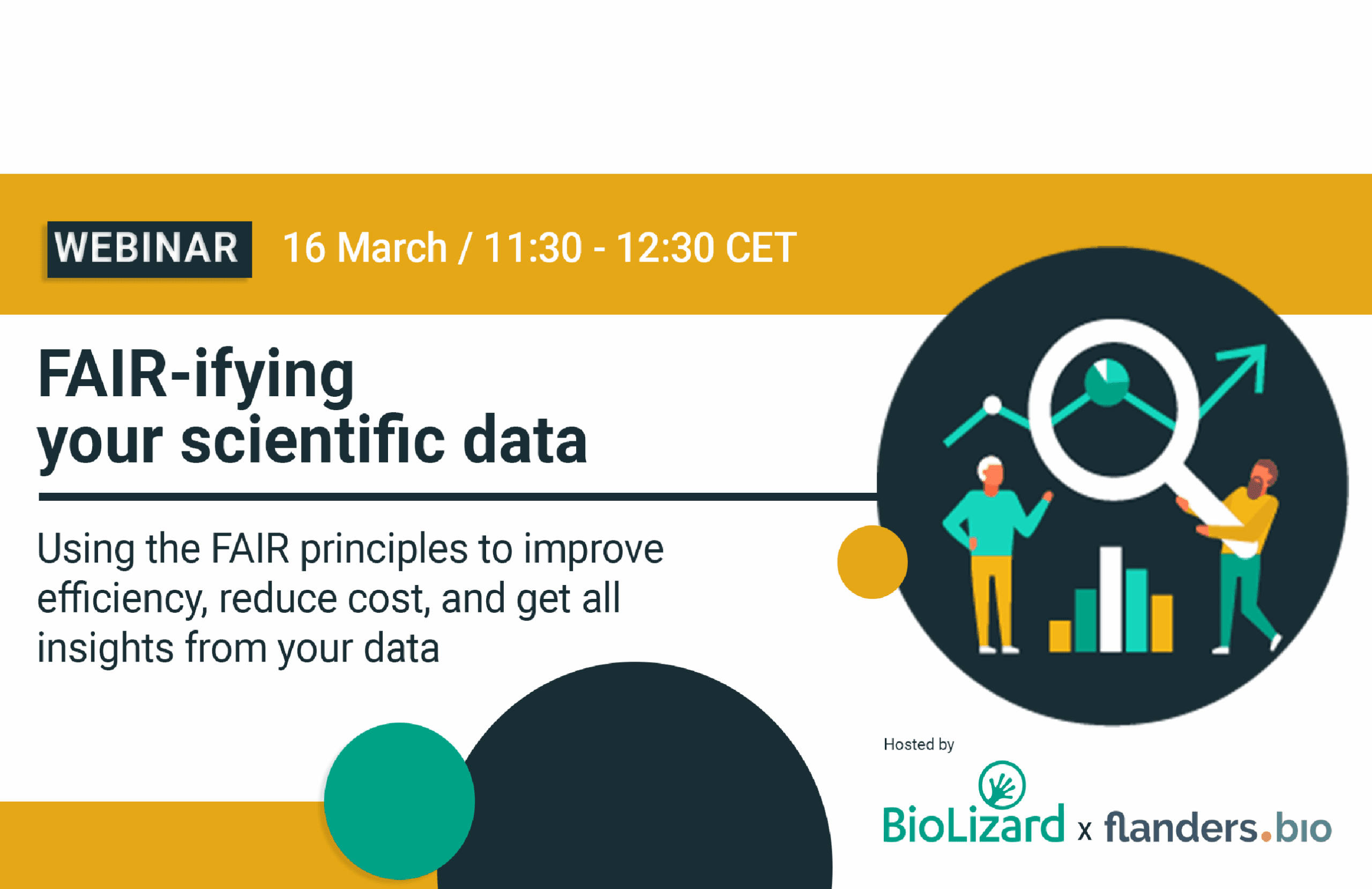
Having a great R&D data management plan can provide considerable returns, both in generating the best scientific insights from your data, and in saving your organisation a lot of time and money. In our experience, when life science organisations implement an R&D data management plan that follows the principles of FAIR data – thereby improving data findability, accessibility, interoperability, and reusability across the organisation – they gain a competitive edge.
Read our white paper on R&D data management
In this webinar, BioLizard’s experts will provide a theoretical framework and best practices for implementing and maintaining FAIR data principles, as well as present concrete client cases where we successfully supported the adoption of these principles. At the end of the webinar, you will understand the principles of FAIR data and how they can be applied to improve data findability, accessibility, interoperability, and reusability within your own life science research, as well as the benefits that this can bring to your organization.
This webinar is brought to you in collaboration with flanders.bio.
https://139582766.hs-sites-eu1.com/hs-web-interactive-139582766-76449037512
Why work with us? At BioLizard, our expertise spans both computer science and biology – meaning that we can act as effective translators to align the needs of IT and R&D departments, and design and implement an R&D data management plan that works for all key stakeholders across your life sciences organization.
Prefer to do some more reading before you reach out to us? No problem, we have lots of free information to share with you!

BioLizard is proud to have received the Best Poster Award at the European Society for Spatial Biology (ESSB) conference, recognising our work on benchmarking cell segmentation methods for single-cell spatial transcriptomics.
Paul Vauterin has transitioned from Chief Technology Officer (CTO) to Chief Operating Officer (COO) at BioLizard, reflecting a shift in focus towards helping organisations integrate AI into their operations and unlock greater value from their data.
For over a century, the life sciences industry has relied on animal models as the standard for predicting drug safety and effect. But today, the industry faces a harsh reality: over 90% of new drugs that appear safe and effective in animal tests ultimately fail in human clinical trials (see for example Ineichen et al. 2024 [1] and Marshall et al. 2023[2])